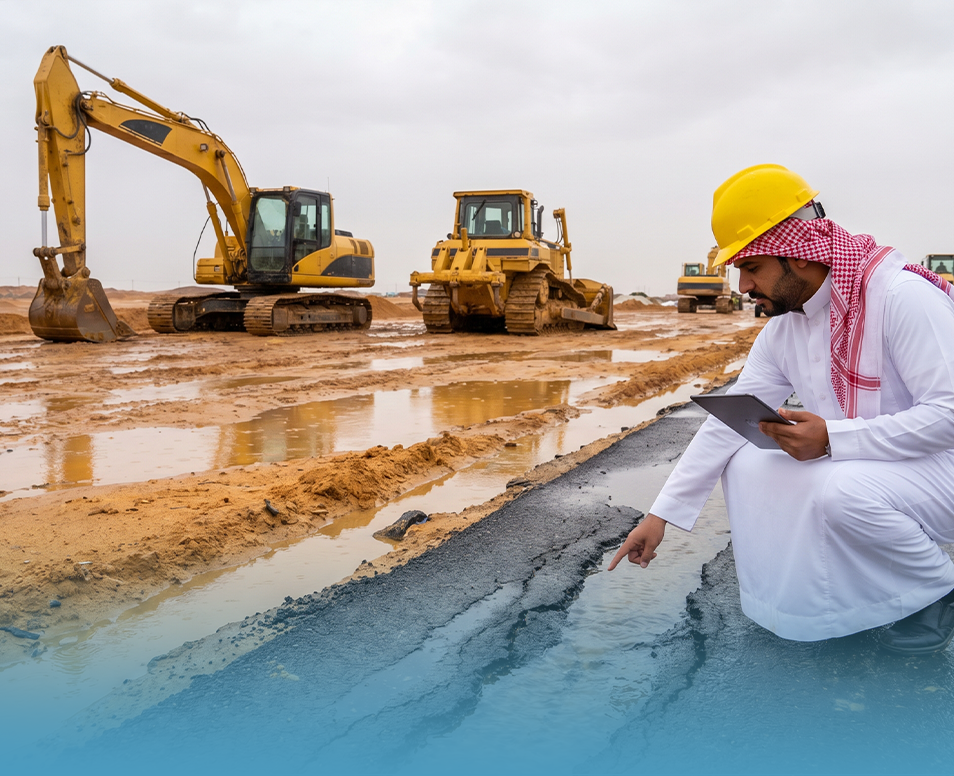
Stormwater Drainage in Roads: 10 Execution Mistakes That Cause Pavement Settlement and Cracking
Start here: If you want a road that does not settle or crack, design and execute a clear drainage system, monitor it daily during construction, and do not allow any step related to water management to be overlooked.
Why is stormwater drainage the decisive factor?
Stormwater drainage in roads is the system that prevents water from accumulating within pavement layers. Every road project needs it to ensure long-term stability. The outcome is a durable pavement that resists early settlement and cracking.
The problem is not the rain itself—it is ignoring it during execution. If water is not properly directed, it will infiltrate the soil and pavement layers, gradually weakening them until defects appear.
10 execution mistakes that lead to pavement failure
Ignoring road slopes during execution
Do this: Ensure slopes are implemented exactly as per design, without unapproved field adjustments.
Without proper drainage direction, water accumulates and infiltrates lower layers, weakening the structure.
Failure to clean drainage paths
Do this: Continuously clean channels and drains during construction.
Obstructions prevent water flow and turn the system into a collection point.
Placing soil layers without proper moisture control
Do this: Execute layers at optimal moisture content—neither too dry nor oversaturated.
Unstable soil under water exposure leads to future settlement.
Using unsuitable drainage materials
Do this: Use materials that allow water to pass through, not trap it.
Incorrect materials retain water within the pavement instead of draining it.
Not integrating drainage with the overall project
Do this: Connect the drainage system with the surrounding infrastructure.
Any interruption in flow causes water to accumulate in one location.
Lack of inspection during execution
Do this: Inspect every stage before proceeding to the next.
Without inspection, errors remain hidden until they appear as cracks.
Not testing drainage performance
Do this: Physically test water flow before project handover.
Theoretical checks are not enough—verify actual performance on site.
Unprotected drainage inlets
Do this: Protect drainage openings from blockage.
Debris and soil can quickly clog the system.
Ignoring low points
Do this: Immediately address any low-lying areas.
Low spots become water zones, leading to localized failure.
Failure to document drainage works
Do this: Document every step of drainage execution.
Documentation supports quality control and prevents repeated mistakes.
How does drainage impact overall road quality?
Stormwater drainage is a core component of road quality. Every infrastructure project depends on it to ensure long-term performance. The result is a road that lasts longer with fewer defects.
That’s why drainage should never be treated as a separate task. It must be integrated with all roadworks under a unified execution approach, such as comprehensive roads and bridges services.
How do you ensure these mistakes don’t happen again?
Do this:
- Review drawings before execution
- Monitor work daily
- Test each stage before proceeding
- Document every step
- Never rely on assumptions
These practical steps prevent most road failures before they occur.
Why choose MIPCO?
MIPCO delivers integrated contracting solutions across MEP works, industrial fabrication, and infrastructure projects. We help you execute road projects to the highest quality standards by controlling every phase—from design through to final handover.
Lead Expert Profile:
“[Name] — Managing Director, PMP® certified / Saudi Council of Engineers, with over 15 years of experience delivering infrastructure and road projects in compliance with Saudi standards.”
Methodology:
“All projects are executed in line with ISO 9001 quality standards and safety management systems, with full documentation at every stage to ensure execution excellence.”
Certifications:
“ISO 9001:2015 certified — surveillance audit completed in December 2025.”
FAQs – Stormwater Drainage in Roads
Q: What services does MIPCO provide?
A: We specialize in MEP contracting, industrial fabrication, steel structure manufacturing, project management, and maintenance services. Each service includes design support, procurement, installation, and commissioning—aligned with your project scope and Saudi regulatory requirements.
Q: Which sectors do you serve?
A: We focus on oil & gas, petrochemicals, power generation, water treatment, commercial construction, and infrastructure projects across the Kingdom. Our teams understand the technical specifications, safety protocols, and compliance requirements unique to each sector.
Q: Do you handle projects end-to-end?
A: Yes. We manage the full project lifecycle—from initial design consultation and material procurement to fabrication, installation, testing, and final handover. You get a single point of contact with transparent progress reporting.
Q: Do you support urgent or fast-track projects?
A: Yes. We offer accelerated delivery paths for time-sensitive projects while maintaining strict quality, safety, and documentation standards.
Q: Do you provide post-project support?
A: Yes. We offer maintenance contracts, spare parts supply, and technical support for completed projects, with rapid response for critical issues.



 MEPCO
MEPCO