
MEPCO is one of the leading construction and contracting companies in Saudi Arabia. Established in 1420 AH, the company has been steadily progressing to keep pace with the rapid urban development witnessed in the Kingdom.
MEPCO is one of the leading construction and contracting companies in Saudi Arabia. Established in 1420 AH, the company has been steadily progressing to keep pace with the rapid urban development witnessed in the Kingdom.


 MEPCO
MEPCO
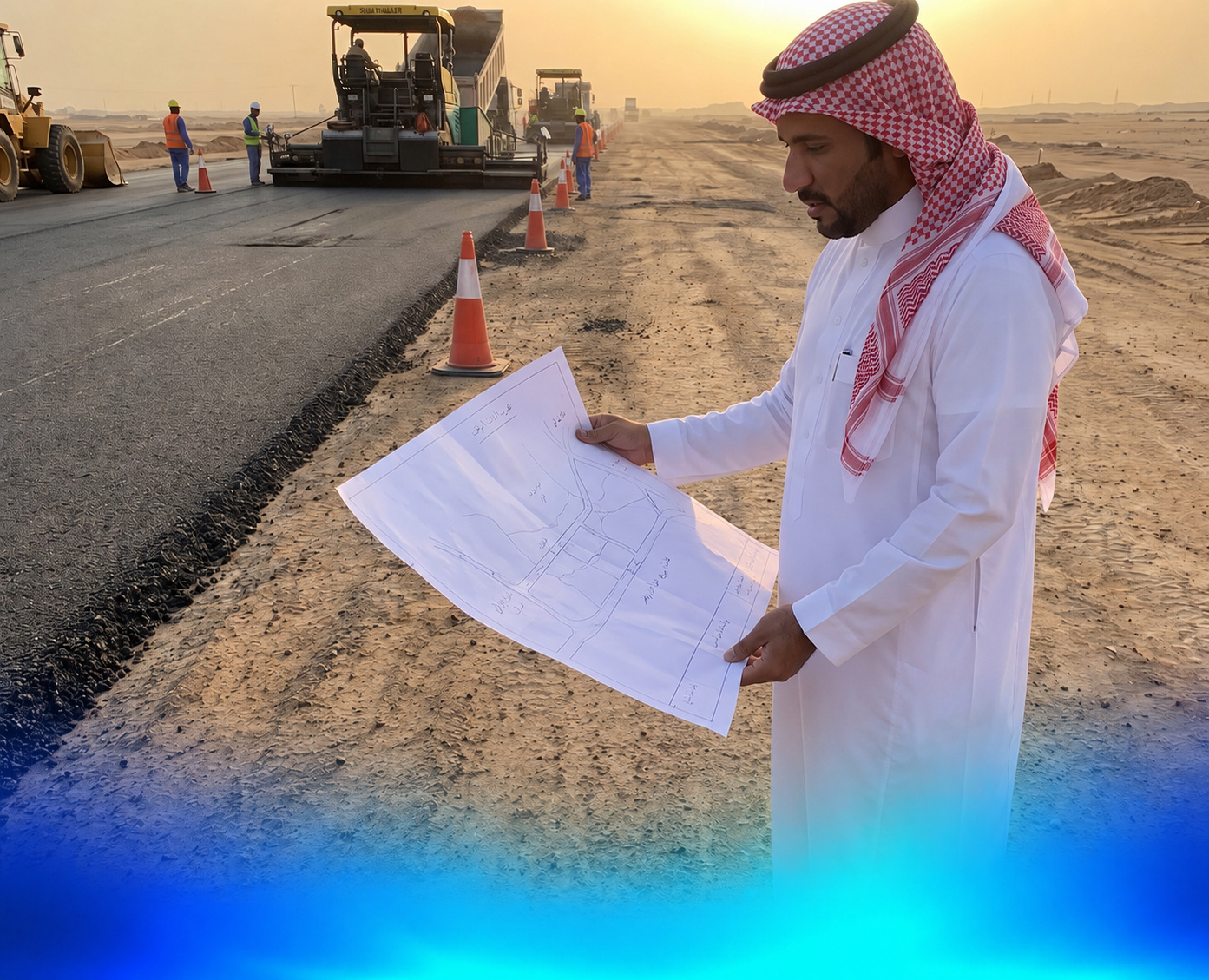
Road construction in populated areas is fundamentally different from building a new road in an undeveloped location. The contractor is not dealing only with soil layers, base courses, and asphalt. The project is being executed within an active environment containing vehicles, pedestrians, residential and commercial entrances, water and sewer networks, electrical and telecommunications services, emergency routes, and facilities that need to remain operational throughout construction.
For this reason, project success should not be measured only by the quality of the final pavement. It should also be assessed by how effectively the execution plan supports disruption reduction, maintains traffic safety, preserves access to affected properties, and prevents every field adjustment from becoming a new traffic problem.
The question that a municipality or project owner should ask before work starts is not only:
“How long will the contractor need to pave the road?”
A better question is:
“How will the contractor divide the road into manageable phases while keeping traffic, utilities, access, and construction activities under control throughout the project?”
Saudi road-work requirements also emphasize integrating traffic safety into road projects, minimizing traffic disruption where reasonably possible, providing clear guidance to road users, and continuously inspecting temporary traffic-control arrangements during execution.
Why Is Road Construction More Complex in Populated Areas?
An urban road remains operationally important even while it is under construction.
It may serve:
At the same time, the project may require:
For this reason, closing a large area simply because it is more convenient for the contractor is not necessarily an effective strategy.
At the other extreme, dividing the road into too many small work areas without proper analysis may increase duration, temporary interfaces, equipment movement, and productivity losses.
The objective is to achieve a practical balance between the contractor’s required work area and the continuity of public movement.
What Is the Difference Between a Construction Phasing Plan and a Traffic Diversion Plan?
This distinction is essential.
Construction Phasing Plan
It answers questions such as:
Temporary Traffic Control or Diversion Plan
This focuses on how road users will move during each construction phase, including:
The phasing plan explains how the road will be built.
The traffic plan explains how people will use the area while the road is being built.
The two should be developed together.
Why Should Road Construction Be Divided Into Clear Phases?
Saudi infrastructure guidance recognizes the use of phased traffic-diversion arrangements that allow traffic to be transferred progressively while coordinating with the relevant traffic authority before implementation.
However, phasing should not be limited to vehicle diversion alone.
Each construction phase should function as a manageable work unit with:
The transition between phases then becomes an engineering and management decision rather than simply moving barriers forward.
Step One: Study the Area Before Dividing the Road Into Phases
Do not begin by opening the road drawing, dividing the route into equal lengths, and naming them Phase 1, Phase 2, and Phase 3.
Effective phasing begins with understanding the surrounding environment.
Review:
A certain phase length may be practical on one street and completely unsuitable on another because of an intersection, school, hospital, or commercial development.
Step Two: Divide the Project According to Constructability, Not Length Alone
When preparing phased road construction, each phase can be tested using one question:
“Can the contractor complete the core works in this section without opening another area before the current one is sufficiently stable and ready for transition?”
A phase may include:
If part of this chain depends on an approval, unavailable material, or an incomplete utility diversion, opening the phase too early may create a stalled work zone in the middle of an active neighborhood.
How Do You Determine the Appropriate Phase Size?
There is no single distance or work-zone length that is appropriate for every road project.
The decision is influenced by factors such as:
| Factor | Impact on Phasing |
| Traffic density | May require maintaining more lanes or using smaller phases |
| Number of entrances | Increases the need for phased-access solutions |
| Intersections | May require independent phases |
| Existing utilities | May control the excavation sequence |
| Road width | Determines whether traffic can remain open beside the work zone |
| Type of work | Paving differs from utility diversion or structural works |
| Equipment | Requires adequate safe operating space |
| Duration | Longer closures increase community impact |
| Alternative streets | Increase or reduce diversion flexibility |
| Night work | May create different options where permitted and appropriate |
The objective is therefore not to maximize or minimize the number of phases.
It is to create a reasonable production area with a manageable level of disruption.
Step Three: Prepare a Temporary Traffic Control Plan for Every Phase
A temporary traffic-control plan should not remain unchanged from the first day to the last if the work-zone conditions change.
It should reflect each stage of construction.
Saudi road-work guidance treats temporary traffic control as a system intended to maintain road-user movement through or around work zones while protecting the public, workers, and equipment. The arrangement should also be understandable and provide road users with enough time to make decisions.
Depending on the project, temporary traffic-control areas may include:
The dimensions and arrangements of these zones should not be copied generically from one project to another. They depend on the road type, speed environment, work activity, duration, and approved standards.
Why Is the Buffer Area Important?
A buffer area is not extra space available for storing construction materials.
Its role is to separate traffic from the active work area and provide a safety margin within the temporary traffic-control arrangement.
Saudi work-zone guidance also requires buffer areas to remain clear and not be used for project-material storage.
This demonstrates the important difference between:
Space that physically exists on site
and:
Space that the contractor is operationally allowed to use.
Step Four: Do Not Plan for Vehicles and Forget Pedestrians
In populated areas, pedestrians are a fundamental part of traffic management.
Closing a sidewalk without providing a practical alternative may force people into traffic lanes or bring them dangerously close to construction equipment.
Particular attention may be required for:
Temporary pedestrian routes should therefore be planned before the sidewalk is closed, not improvised after pedestrians begin walking between barriers.
The objective is to maintain a route that is understandable, reasonably direct, and separated from hazards according to the project’s approved traffic and safety requirements.
Step Five: Maintain Access to Homes, Shops, and Facilities
One of the most common sources of conflict between a road project and the surrounding community is unplanned access closure.
For every phase, identify:
In some areas, access may be maintained throughout the phase.
In others, temporary closure may be necessary.
The important point is that it should be planned, coordinated, and communicated according to project and authority requirements, rather than becoming a surprise when equipment reaches the entrance.
Step Six: Treat Intersections as Small Projects Within the Main Project
An intersection is not simply another length of road.
It combines multiple traffic movements, pedestrian crossings, turning movements, possible traffic signals, and often dense underground utilities.
It may therefore require an independent phase or internal sub-phasing.
Before beginning intersection works, review:
Opening several sensitive intersections at the same time without considering the network-wide traffic impact may multiply disruption instead of accelerating delivery.
Step Seven: Coordinate Utilities Before Removing the Road
In many urban road-development projects, the biggest cause of delay is not the asphalt. It is the infrastructure underneath.
Possible utilities include:
If the contractor removes the road and then discovers that a utility diversion has not been approved, the work zone may remain open without meaningful progress.
This is why the phasing plan should be linked to a utility matrix showing:
Where information remains unclear, an RFI – Request for Information can be raised through the project procedures instead of making an undocumented field decision.
Step Eight: Plan Site Logistics Before Installing Barriers
Site management is not only about where workers stand.
Before each phase starts, ask:
A diversion may be excellent for public traffic but make contractor access impractical.
When this happens, teams may begin opening barriers and changing routes informally, which weakens overall control.
Step Nine: Include Temporary Drainage in Every Phase
The permanent drainage system may only be completed near the end of the project.
But what happens if rainfall occurs during an intermediate phase?
The project should consider:
Temporary drainage solutions should be based on the project and site conditions rather than improvised in a way that transfers the problem from one area to another.
Step Ten: Barriers, Signs, and Lighting Require Continuous Control
Setting up a work zone is not a one-time activity completed on the first morning.
Conditions change every day.
The following may move or become damaged:
This may happen because of equipment movement, weather, subcontractor activities, or phase changes.
Temporary traffic-control elements should therefore be inspected regularly to confirm that they still communicate a clear message to road users.
Signs of weak control include:
Step Eleven: Test the Diversion After It Is Implemented
A traffic-diversion drawing may appear clear on paper, but drivers experience it at speed and under real traffic conditions.
After implementation, observe:
Post-implementation monitoring allows approved improvements to be made before the same problem repeats.
Step Twelve: Do Not Leave Each Phase Open Longer Than Necessary
One advantage of phased construction is that every closed area becomes a clear commitment by the contractor.
If an area is closed and then left inactive for weeks because of:
then the community continues to suffer disruption without receiving corresponding construction progress.
The opening of a phase should therefore be linked to reasonable readiness, including:
A construction phase should not become a way to reserve public road space while the contractor is still preparing.
Step Thirteen: Do Not Over-Fragment the Project
More phases do not automatically mean less disruption.
Excessive fragmentation may create:
The contractor and consultant therefore need to balance:
The minimum acceptable level of traffic disruption
with:
The work area required to execute safely, efficiently, and to the required quality.
The correct balance is project-specific.
How Should Construction Phases Be Linked to the Baseline Schedule?
Road phases should appear clearly in the Baseline schedule instead of having one general activity called “road works.”
Each area or phase can be linked to activities such as:
This allows the project owner to identify where delay is actually occurring.
If asphalt crews are ready but the water-utility diversion is late, increasing paving equipment will not solve the problem.
How Does the Critical Path Affect the Decision to Open a New Phase?
Not every delay has the same effect on project completion.
One phase may slip slightly without affecting the final date, while another may depend on a critical intersection closure or utility diversion that lies directly on the Critical Path.
Before opening another work front, ask:
“Will this new phase genuinely help recover the schedule, or will it simply create another active work zone while the true critical constraint remains unresolved elsewhere?”
Opening more work fronts is not always an acceleration strategy.
Sometimes removing the critical constraint is more effective.
When Can an Acceleration Plan Create Traffic-Safety Risk?
When a project falls behind, the contractor may propose:
These options can be evaluated, but each may change the risk profile.
For example:
More work fronts may mean more diversions.
Night work requires review of visibility, lighting, noise, and local restrictions.
More equipment increases traffic density inside the work zone.
The safety, traffic, and logistics plans should therefore be updated when the execution strategy changes rather than modifying only the schedule.
How Can Traffic Safety Be Maintained Around the Work Zone?
Traffic safety begins before the driver reaches the first barrier.
Work-zone management generally needs to consider:
Saudi road requirements call for approved traffic-management arrangements for project access and movement, along with appropriate barriers, lighting, temporary signage, and safe alternatives where lanes are closed or reduced according to the specific situation.
Detailed arrangements should follow the road classification, approved plan, and relevant authority requirements rather than a generic template.
Why Is the Transition Between Two Phases a High-Risk Period?
When the contractor moves from one phase to another, several things may change within a short period:
This transition deserves its own plan.
A common mistake is leaving the site at the end of a shift in a condition that is half old arrangement and half new arrangement.
There should be a clearly defined state in which the road will be left for public use, especially if the transition requires several hours.
What Role Does Communication With Residents and Road Users Play?
Even a well-designed diversion may cause confusion if it appears without adequate notice.
Depending on project requirements and authority procedures, communication may be useful regarding:
Saudi infrastructure guidance also recognizes advance notification for certain major diversion conditions and significant closures.
The objective is not project promotion. It is to give road users an opportunity to change their travel decision before reaching the congestion point.
Which Indicators Should the Project Manager Review Daily?
It is not enough to ask:
“Is the diversion working?”
Useful monitoring indicators may include:
| Indicator | What It May Reveal |
| Condition of barriers and signs | Quality of traffic control |
| Unexpected congestion | Weak phase design or changed traffic conditions |
| Incidents or Near Misses | Hazard points requiring intervention |
| Access complaints | Property-access or communication problems |
| Pedestrian route violations | Temporary route is impractical or unclear |
| Delay within the phase | Risk of closure continuing without progress |
| Utility conflicts | Weak advance coordination |
| Material accumulation | Logistics problem |
| Water inside the work area | Poor temporary drainage |
| Quality observations | Potential rework and delayed reopening |
The value comes from taking action when the indicators show a negative trend.
Which Mistakes Increase Road-Project Disruption?
Closing More Area Than the Contractor Can Actually Work On
A larger closed work zone does not increase productivity if sufficient teams, materials, and equipment are not available.
Opening Several Work Fronts Without Completing Any
The community becomes surrounded by construction areas while actual progress remains limited.
Treating the Diversion Plan as Fixed
Project conditions change, so the traffic arrangement should be reviewed when the construction phase changes.
Ignoring Property Entrances
The road may technically remain open to through traffic while becoming unusable for residents or businesses.
Discovering Utilities After Excavation
This can lead to stoppages, design changes, RFIs, and schedule impacts.
Storing Materials Inside Buffer Areas
This undermines the safety function of the separation between traffic and the work zone.
Leaving Old Markings in Place
Conflicting visual messages confuse drivers.
Delaying Quality Tests
A pavement layer may be completed and then found non-compliant only after another layer has been placed, increasing rework.
Reopening Before the Phase Is Truly Ready
Pressure to restore traffic quickly may result in an area being reopened and then closed again later for incomplete work.
How Should the Consultant Review Phase Readiness Before Closure Begins?
A readiness gate can be used before each phase begins.
Planning
Traffic
Utilities
Execution
Safety
Quality
If these elements are not ready, the key question becomes:
“What is the real benefit of closing the road now?”
How Does Tender Readiness Affect Urban Road Projects?
Many execution problems begin before the contractor mobilizes.
If a project is tendered while:
the contractor will face more decisions during construction.
A Tender Readiness review can help identify such gaps before contract award.
The objective is not to know every possible site detail in advance. It is to reduce major uncertainties that could reasonably have been addressed before construction.
How Should You Select a Road Contractor for a Populated Area?
During Prequalification, do not ask only about asphalt quantities or equipment numbers.
Ask:
The right contractor for this type of project is not simply the one that can build the road.
It is the one that can manage the surrounding area while the road is being built.
How Does MEPCO Support Road and Bridge Projects?
MEPCO’s Road and Bridge Projects capabilities include engineering planning, excavation and backfilling, base-course preparation, asphalt paving, drainage systems, road lighting, rehabilitation of existing roads, infrastructure and utility installation, horizontal drilling, coordination with relevant authorities, and quality testing for materials and pavement layers.
The service methodology also extends from site assessment and engineering planning through execution and supervision to quality testing and handover.
This integrated scope is especially relevant to road construction in populated areas, because the project is not simply a paving operation.
It requires coordination between:
The more these elements are managed in isolation, the greater the risk of conflicts and rework.
What Information Helps When Requesting a Technical Proposal for a Road Project?
If a municipality, developer, or consulting firm is evaluating a road project in an active urban area, useful information may include:
An initial project review can help identify additional information required before finalizing the execution phases and resource plan.
Frequently Asked Questions About Road Construction in Populated Areas
What Is the Best Way to Execute Road Works in Populated Areas?
There is no single plan suitable for every road. Effective delivery generally depends on dividing the project into manageable phases and linking each phase to temporary traffic arrangements, utilities, logistics, safety, and quality while maintaining access as far as reasonably practical.
What Does Phased Road Construction Mean?
It means dividing the project into areas or stages that are completed sequentially instead of closing the entire road at once, while defining how vehicles, pedestrians, and access arrangements change between phases.
Does Phased Construction Always Reduce Disruption?
It can help, but excessive fragmentation may increase project duration, diversions, temporary works, and equipment movement. The objective is to select a phase size and number that balance traffic needs with execution efficiency.
Why Is a Temporary Traffic-Control Plan Important?
It organizes the movement of vehicles and pedestrians through or around the work zone and defines lanes, warnings, barriers, transition areas, and alternative routes according to project and authority requirements.
How Can Access to Homes and Shops Be Maintained During Construction?
Affected entrances should be identified within each phase, and alternative access or partial construction methods should be reviewed in advance where practical. The appropriate solution depends on road width, work type, and the affected property.
Why Should Utilities Be Coordinated Before Road Works Begin?
Discovering a conflicting water, electrical, or telecommunications line after pavement removal may stop the phase until a solution is developed and approved, increasing disruption and rework.
What Are the Main Traffic-Safety Risks During Road Construction?
Risks may include unclear lane changes, poor separation between vehicles and workers, equipment movement, pedestrian conflicts, inadequate nighttime visibility, conflicting markings, and poorly communicated diversion changes.
Can the Entire Project Be Built at Night to Reduce Congestion?
This depends on the work type, location, authority requirements, noise restrictions, lighting, resources, safety, and quality. Night work may suit certain activities but is not a universal solution for every project.
What Is the Consultant’s Role in Road Construction Phasing?
According to project responsibilities, the consultant may review phase readiness, traffic plans, specifications, quality requirements, safety arrangements, testing, and coordination before allowing transitions between activities and phases.
How Do Construction Phases Affect the Baseline Schedule?
The phases should be linked to the schedule so that activities and constraints affecting each area and reopening date can be tracked rather than treating the entire road as one long activity.
How Can I Tell Whether a Contractor Is Suitable for Work in a Populated Area?
Review its experience in phasing, temporary traffic management, existing utilities, site logistics, safety, authority coordination, quality, and communication—not only its paving experience.
What Happens if an Undocumented Utility Is Discovered?
The area should be controlled, the utility identified, and its impact reviewed under the project procedures. An RFI or other required coordination should be completed before an unapproved technical change is made.
Conclusion: A Successful Road Project Starts With Managing Everything Around the Road
Road construction in populated areas requires a wider perspective than excavation, backfilling, and paving.
The contractor is working on a road that must continue serving a community, facilities, and utility systems throughout construction. This makes site management, traffic safety, disruption reduction, and phased execution core elements of project quality.
A good execution plan does not attempt to keep everything open regardless of construction needs, nor does it close the largest possible area simply to make equipment operations easier.
Instead, it seeks a balance between:
A safe and productive work zone + manageable traffic + practical access + coordinated utilities + inspectable quality + a controllable schedule.
This becomes especially important in road projects across Riyadh and other Saudi cities with significant residential and commercial activity, where a single phasing decision can affect thousands of daily trips, property entrances, and local businesses.
If your project involves construction, upgrading, rehabilitation, intersection works, paving, or associated infrastructure within a populated area in Saudi Arabia, you can share the available project scope, drawings, schedule, traffic information, and utility data with the MEPCO team to discuss the execution methodology and request a technical or commercial proposal.
Construction phases, traffic diversions, safety arrangements, and closure durations vary according to road type, width, traffic volume, project scope, existing utilities, owner requirements, and relevant authority requirements. Actual site conditions and current applicable standards should therefore be reviewed before the final execution plan is approved.